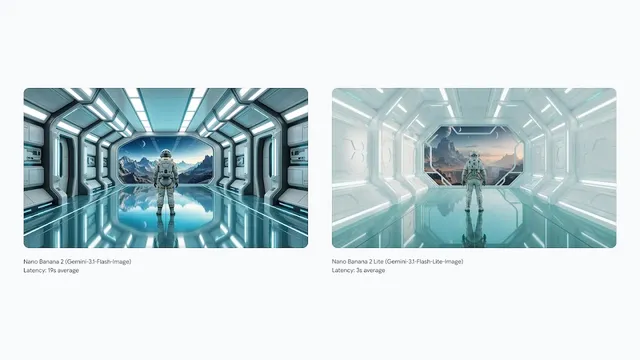
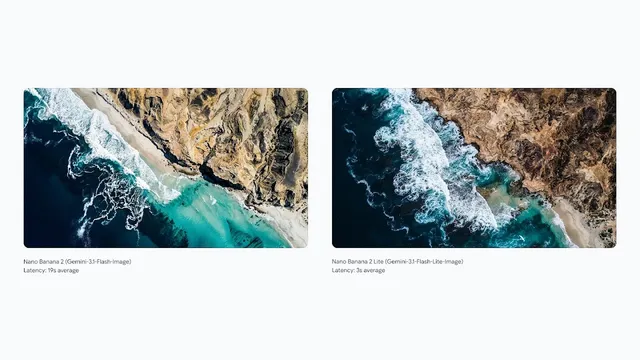
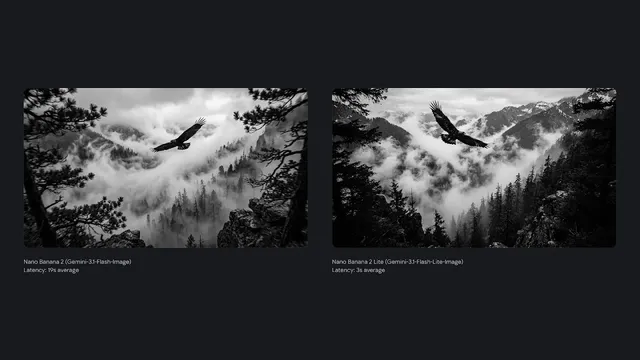
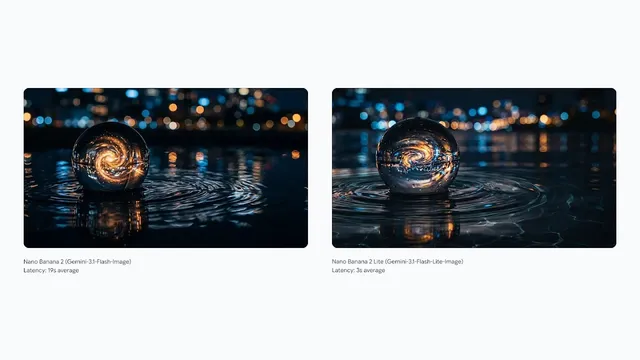
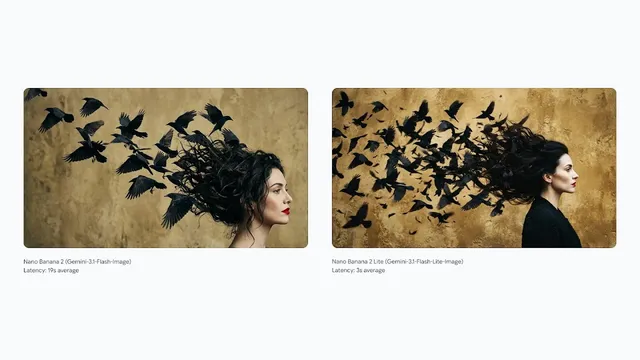
Nano Banana 2 Lite is Google's name for Gemini 3.1 Flash-Lite Image. Google launched it on June 30, 2026 as "our fastest, most cost-efficient image model in the Nano Banana family yet, built for high throughput, speed and scale." The images on this page are Google DeepMind's official side-by-side examples: on the left, Nano Banana 2; on the right, Nano Banana 2 Lite, from the same prompt.
Built for speed
Google gives three measures of how fast it is. The Gemini API page says it targets "sub-2 second end-to-end latency." The launch post says it "delivers text-to-image outputs in 4 seconds." On Google DeepMind's comparison images, Nano Banana 2 averages 19 seconds and Nano Banana 2 Lite averages 3 seconds.
Quality that keeps up
Google says that "despite prioritizing speed, Nano Banana 2 Lite retains reliable prompt adherence, strong character consistency and legible in-image text rendering."
How it scores
Google DeepMind's model card reports human side-by-side Elo scores. On general text-to-image, Lite scores close to Nano Banana 2; on general editing, the gap is larger.
| Benchmark (Elo) | Nano Banana 2 Lite (Thinking) | Nano Banana 2 | Nano Banana Pro |
|---|---|---|---|
| General text-to-image | 1059 | 1080 | 1018 |
| Visual design | 1047 | 1066 | 1009 |
| General editing | 983 | 1062 | 1054 |
Made for many fast edits
The Gemini API page lists "fast multi-turn local edits (swapping colors, sticker creation, background adjustments)" among its key capabilities. Partners describe the same strengths:
Nano Banana 2 Lite combines exceptional character consistency with low latency, enabling responsive, realistic generative photo effects at a price point that scales to our millions of active users.
Nano Banana 2 Lite is fast and reliable, helping designers explore more ideas to craft unique images on Figma Weave's node-based canvas.
Specs
| Nano Banana 2 Lite | |
|---|---|
| Model ID | gemini-3.1-flash-lite-image |
| Released | June 30, 2026 (generally available) |
| Input | Text, images and video |
| Output | Images |
| Resolution | 1K only (1024 × 1024 px for 1:1) |
| Aspect ratios | 14, from 1:1 to 1:8 and 8:1 |
| Reference images per prompt | Up to 14 |
| Input token limit | 65,536 |
| Search grounding | Not supported |
Pricing
Google lists Nano Banana 2 Lite at "$0.034 per 1K image." On the global endpoint of Gemini Enterprise Agent Platform, image output is $30 per million tokens, and a 1K image uses 1,120 output tokens. Text, image and video input costs $0.25 per million tokens. These are Google's prices as of October 2, 2026.
Nano Banana 2 Lite, 2 or Pro?
Google describes the family this way:
| Model | Google's description |
|---|---|
| Nano Banana 2 Lite | "Built for speed. Optimized for near-real-time, high-volume workflows where ultra-low latency is critical." |
| Nano Banana 2 | "The generalist workhorse. Delivers high quality at a lower latency, offering the best balance of performance and cost." |
| Nano Banana Pro | "Optimized for complex, professional use cases." |
Google also recommends Nano Banana 2 Lite as the replacement for the original Nano Banana (gemini-2.5-flash-image).
Frequently asked questions
Is Nano Banana 2 Lite the same as Gemini 3.1 Flash-Lite?
No. Gemini 3.1 Flash-Lite is a text and multimodal model that Google announced in March 2026. Nano Banana 2 Lite is the image model Gemini 3.1 Flash-Lite Image, which is built on Gemini 3.1 Flash-Lite and was released in June 2026.
Can it make 2K or 4K images?
No. The Gemini API page states that only 1K is supported and that 2K and 4K are not.
Where can I use it?
Google released it in Google AI Studio, the Gemini API and Gemini Enterprise Agent Platform, and is rolling it out in the Gemini app, AI Mode in Search and other Google products.
How can I tell an image was made with AI?
SynthID watermarking is always on, and the model supports C2PA Content Credentials.